
Stormwater Report Card for Miami-Dade County
MS4 permit compliance for Miami-Dade County and its municipalities from 2021 to 2023
Stormwater Report Card for Miami-Dade County
Miami Waterkeeper, Everglades Law Center, P.E.E.R. Group, University of Miami Environmental Justice
June 4, 2026
Executive Summary
Biscayne Bay is one of Miami-Dade County’s most vital natural and economic resources, but it is under growing stress from pollution, urbanization, and climate change. Stormwater runoff, which carries nutrients, sediments, and other pollutants into the Bay, is a leading cause of its decline. Effective stormwater management is therefore central to protecting water quality, reducing flooding, and ensuring long-term community resilience.
This report evaluates stormwater management compliance across Miami-Dade municipalities, with a focus on Municipal Separate Storm Sewer System (MS4) permits issued under the Clean Water Act. MS4 permits regulate how cities and counties manage stormwater that flows through their public drainage systems, such as storm drains, pipes, canals, outfalls, and retention basins, to ensure that pollutants are controlled before runoff reaches local waterways like Biscayne Bay. These permits require municipalities to implement a series of stormwater management practices covering public education, inspections, construction oversight, and pollution prevention.
Building on the findings of the 2022 Stormwater Compliance Report, this report re-evaluates the performance of 34 Municipal Separate Storm Sewer System (MS4) permittees in Miami-Dade County, including the County, its 32 co-permittees, and the Cities of Miami and Hialeah, during permit Years 4–6 (2021–2023). Using quantitative and qualitative rubrics, six independent reviewers assessed municipal compliance with key MS4 requirements.
When evaluated on quantitative compliance, Miami-Dade County and its 32 co-permittees averaged 76.5% (C), while the City of Miami scored 91% (A-) and the City of Hialeah scored 81% (B-). Qualitative compliance scores followed a similar pattern, with the County and co-permittees averaging 73.8% (C), the City of Miami earning a 96% (A), and the City of Hialeah scoring 72% (C-).
Read the Full report
Introduction
South Florida was once a continuum of natural habitats, including wetlands, stretching from the Everglades to Biscayne Bay, and acted as a natural sink for rainwater. The County’s urbanization transformed wetlands and other natural areas into hard surfaces, roads, buildings, and compacted soil. As a result, the earth’s natural capacity to absorb rain has diminished. A network of engineering controls is now required to manage the water flowing in South Florida to keep dangerous flooding at bay.
Because of stormwater’s potential to carry pollution to the waters of the United States, the Clean Water Act regulates stormwater discharge by way of the Municipal Separate Storm Sewer System (MS4). The Environmental Protection Agency delegated authority to the Florida Department of Environmental Protection (FDEP) to manage stormwater pollution within its borders. FDEP provides regulatory oversight to ensure that stormwater management structures are adequately designed to manage water quality and quantity. Counties and municipalities are required to have a Municipal Separate Storm Sewer System (MS4) permit to discharge stormwater in waterways.
MS4 permit types are based on population; a Phase I Permit serves urban populations of 100,000 or more, while a Phase II permit serves smaller urban populations.
Miami-Dade County and Biscayne Bay
Three Phase I MS4 permits authorize large municipal stormwater discharges in Miami-Dade County. The Permittees include 1) Miami-Dade County and 32 municipalities as Co-permittees, 2) the City of Miami, and 3) Hialeah.
Stormwater management in Miami-Dade County is essential to public health and water quality, as clean water makes Miami, Miami. Biscayne Bay is an ecological and aesthetic jewel and sits at the heart of the community. With 2.8 million residents and millions of visitors every year, the Bay contributes billions of dollars to the local economy. Despite existing protections, it is still impacted by ongoing pollution events, resulting in algae blooms, fish kills, and declining seagrass. Miami-Dade’s outdated stormwater management infrastructure, further compromised by sea-level rise and changes in precipitation patterns, exacerbates the significant amount of pollution that stormwater transports into surface waters.
Methodology
This report analyzes the performance of Miami-Dade County, its 32 co-permittees, and two individually permitted municipalities—the City of Miami and the City of Hialeah—to evaluate the level of compliance with the MS4 Phase I permits (Miami-Dade County and Co-permittees permit is FLS000003, the City of Miami’s permit is FLS000002, and the City of Hialeah, FLS000023). The review covered Years 4 through 6 (2021–2023) of the current MS4 reporting cycle.
This report serves as a follow-up to An Audit of Miami-Dade County Stormwater Permit Compliance, published by Miami Waterkeeper and the Everglades Law Center in 2022. The original report evaluated municipal compliance using 2020 data (Year 3 of the MS4 reporting cycle) and established a baseline assessment of stormwater program performance across Miami-Dade County. To ensure consistency and allow for meaningful comparisons over time, this follow-up report applies the same evaluation framework and scoring criteria used in the 2022 audit, while expanding the analysis to include additional years of MS4 reporting data. This approach allows the report to track trends in compliance, assess progress on previous recommendations, and identify ongoing gaps and emerging priorities for improving stormwater management across municipalities.
Read the 2022 Stormwater Report
With two types of scoring systems, quantitative and qualitative, the rubric ensures a comprehensive assessment across all major permit components:
- Quantitative Assessment – A binary scoring system where a value of 1 was assigned for the presence of a required document or action (e.g., submission of an Annual Report), and 0 for its absence.
- Qualitative Assessment – A scaled evaluation that can range from 0 to 3, depending on the category, of the quality and substance of compliance, considering whether the permittees met the requirement with sufficient detail, effort, and clarity.
Each of the six evaluators scored all municipalities independently. Once the individual assessments were complete, the evaluation team reviewed and discussed the results. In cases of disagreement, particularly in qualitative categories, evaluators worked collaboratively to reach consensus. We used a simple average of the submitted scores when the scoring team could not reach consensus.
Results
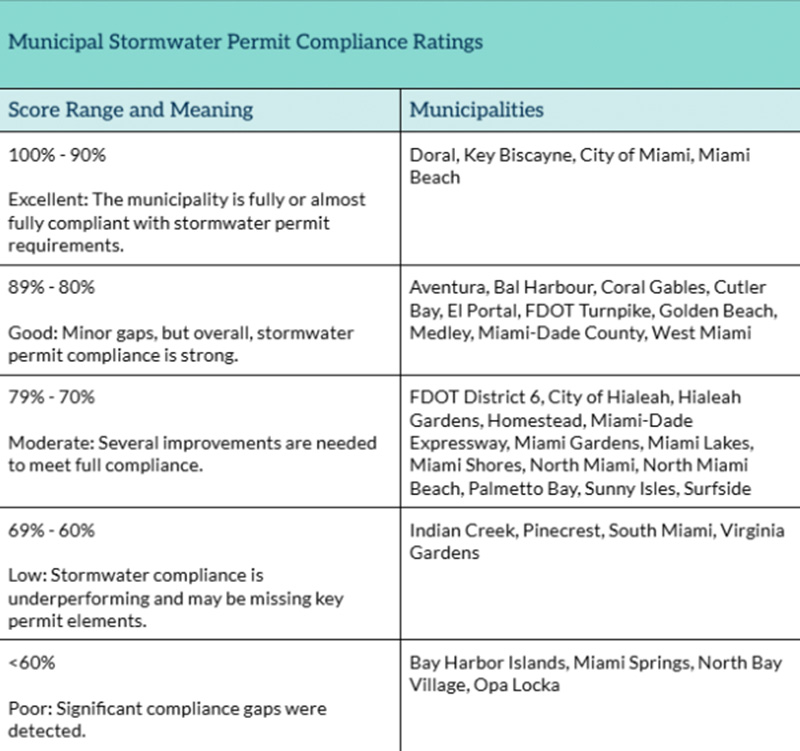
The stormwater compliance assessment shows a range of municipal compliance across Miami-Dade County . Out of 34 municipalities assessed from 2021 to 2023 on average, 14 (41%) achieved Excellent (90–100%) or Good (80–89%) ratings, indicating strong compliance with MS4 permit requirements. Twelve municipalities (35%) scored Moderate (70–79%), suggesting that improvements are still needed. Eight municipalities (24%) fell into the Low (60–69%) or Poor (<60%) categories, reflecting significant gaps in stormwater compliance. Overall, while many municipalities demonstrate solid performance, targeted support and enforcement remain necessary for a substantial portion of the analyzed communities.
Quantitative Compliance
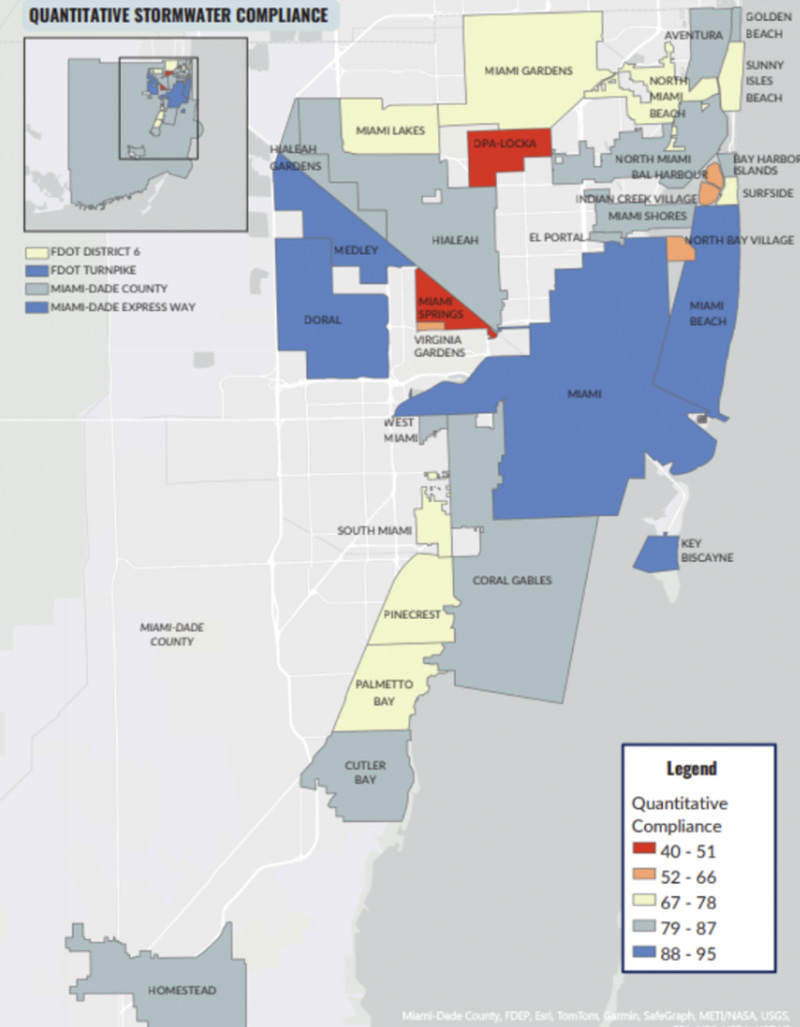
When evaluated against the specific requirements of their MS4 permits — whether annual reports were submitted, outfall maps were in place, inspections were completed, and required attachments were filed — Miami-Dade County and its 32 co-permittees averaged 76.5 percent, the City of Miami scored 91 percent, and the City of Hialeah scored 81 percent. Progress since the 2020 baseline is real: outfall mapping increased from 57.1 to 88.6 percent of municipalities and Stormwater Management Program completion rose from 54.5 to 77.1 percent. Yet routine field inspections tell a different story — stormwater pump inspections fell from 94.1 to 78.9 percent, pollution control box inspections dropped from 53.3 to 41.2 percent, and pipe and culvert inspection rates declined nearly 8 percentage points. Twenty-four percent of municipalities remain in the Low or Poor categories.
Qualitative Compliance
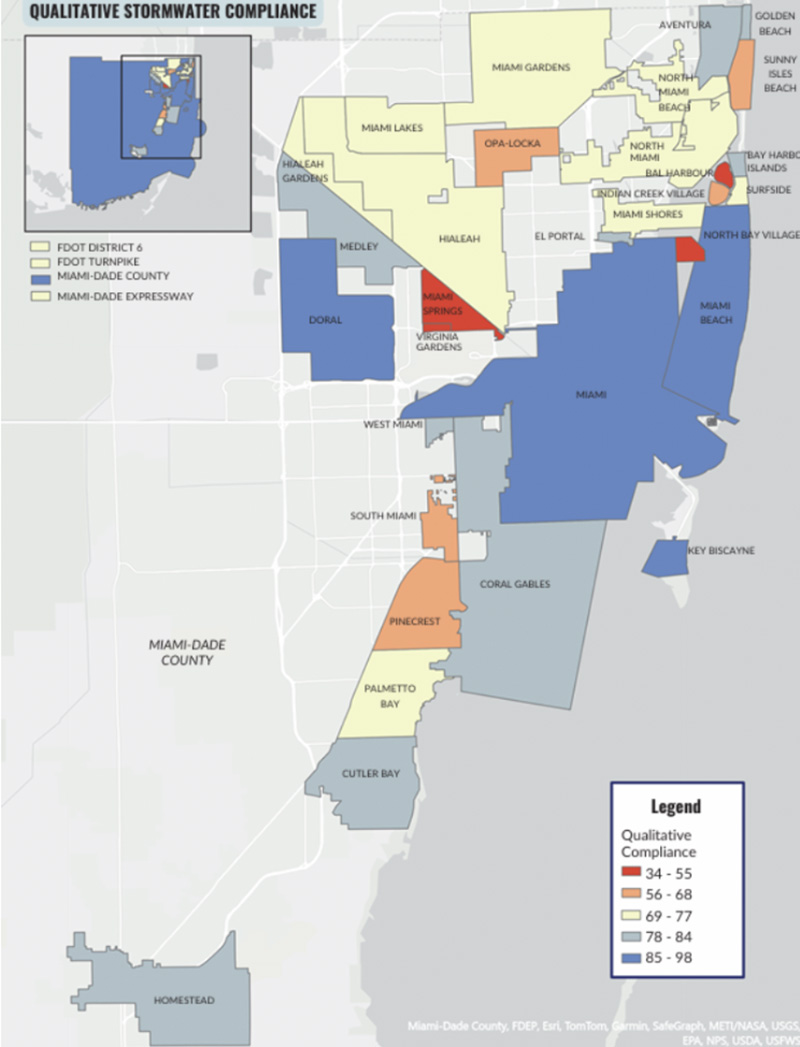
Beyond whether municipalities checked the required boxes, our qualitative assessment examined how well they did so — the depth, accuracy, and thoroughness of their stormwater programs. Here the picture is more nuanced. The County and its co-permittees averaged 73.8 percent, while the City of Miami stood out with a 96 percent qualitative score and the City of Hialeah received 72 percent. High-performing municipalities submitted current, regularly updated Stormwater Management Programs, provided complete and digitized infrastructure maps, engaged residents through multilingual and interactive public education, and demonstrated proactive illicit discharge detection. Lower-scoring municipalities, by contrast, often submitted plans that had not been updated in over a decade, reported inspections that were incomplete or inconsistent, and relied on passive outreach materials with limited community reach.
Recommendations
To sustain progress and close remaining gaps, at a high level, the report recommends:
- Ensuring regular review, updates, and compliance of the municipalities’ Stormwater Management Programs.
- Regular updates to stormwater infrastructure maps – including digitization
- Strengthening inspection and maintenance programs with standardized schedules and digital tracking.
- Expanding proactive illicit discharge detection and reporting.
- Enhancing public education with multilingual, community-based programs.
- Linking stormwater funding and grants to measurable compliance outcomes.
- The County and the State should provide training and technical assistance to under-resourced municipalities.
- FDEP needs to ensure the timely renewal of permit cycles to ensure updated conditions.
- FDEP must conduct periodic compliance audits and require corrective action plans with enforceable timelines for municipalities failing to meet inspection requirements.
Achieving full compliance from all municipalities requires them to implement consistent documentation practices, strong Stormwater Management Programs, comprehensive digital infrastructure mapping, and higher levels of compliance across required inspection and outreach categories. Municipalities would need to ensure that all required inspections are completed at the frequency specified in their MS4 permits, including routine inspections of pumps, pollution control structures, and outfalls, and continue improving proactive illicit discharge detection and public engagement efforts. Strong performance year after year would ensure that high standards translate into long-term protection of Biscayne Bay and resilience against increasing stormwater pressures
Read the Full reportAcknowledgements
This report is a collaboration among Miami Waterkeeper, Everglades Law Center, University of Miami Environmental Justice Clinic and P.E.E.R Group. We thank the Pisces Foundation for supporting this work.
Rachel Silverstein, PhD
Miami Waterkeeper
Adriana González Fernández, Ph.D.
Miami Waterkeeper
Sofia Bond, M.S.
Miami Waterkeeper
Mariana Aziz Pico, LL.M
Ansley Samson, Esq.
Everglades Law Center
Miami Waterkeeper
Elizabeth Fata Carpenter, Esq.
Everglades Law Center
Francesca DiJulio, Esq.
Everglades Law Center
Theresa J. Pinto, Esq., M.S.
P.E.E.R. Group