

Managing Water from Every Direction: Compound Flooding Analysis

The sun’s out, and Miami is flooding without a drop falling from the sky. Why? Due to Miami’s low elevation and porous limestone geology, water wells up from the ground when the water table rises. An average spring rain paralyzes the region with flooded roads, cars, and buildings.  Alarmingly, this is becoming a more frequent […]

Back

The sun’s out, and Miami is flooding without a drop falling from the sky. Why? Due to Miami’s low elevation and porous limestone geology, water wells up from the ground when the water table rises. An average spring rain paralyzes the region with flooded roads, cars, and buildings.  Alarmingly, this is becoming a more frequent reality for Miamians. 
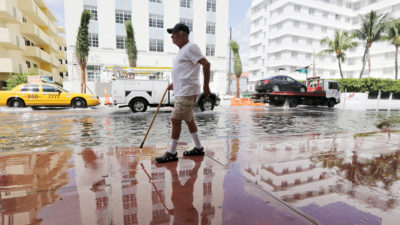
 

                                                                                         High-tide flooding in Miami Beach, Florida in September 2015.

Image credit: Yale 360. Retrieved from: https://e360.yale.edu/features/who-will-pay-for-the-huge-costs-of-holding-back-rising-seas


What’s causing that rise in groundwater? The swelling ocean. Most people think of “flooding” as “storm surge”, where ocean waves crash into our city during storms. But that’s not the only kind of flooding that Miami is facing, and projects designed to keep Miami dry should consider other kinds of water-based impacts.  As tides get higher and higher, groundwater near the coast also rises — with water coming up from below our feet. By now, Miamians are familiar with water surfacing through storm drains and with puddles that stay ponded in low-lying coastal areas.


This graphic illustrates the relationship between sea level and groundwater level. Image credit: Miami Waterkeeper Files


This is why it’s so important to address “compound flooding”. Just as the term suggests, this happens when two or more types of floodwaters merge and swell. Adding a consideration of rising groundwater to storm surge and rainfall will yield more holistic and effective solutions to protect Miami.

What can be done? State, local, and federal agencies need to study water from all directions as they propose solutions for near-future flood risks.  For instance, if the Army Corps is going to analyze the effects of flooding in our city from storm surge, it should also acknowledge and integrate efforts to address rising groundwater and increased precipitation from storms that move more slowly and hover over our city, as climate models predict. This will not be easy nor cheap, but planners need to consider compound flooding early in the design phase, we can’t stress this enough. Learn more from our partners at Environmental Defense Fund here in their excellent blog on comprehensive flood risk management.

Flooding from all directions: How compound flooding threatens urban ...


Image credit: University of Texas. Retrieved from https://sites.utexas.edu/climatesecurity/2020/03/25/flooding-from-all-directions-how-compound-flooding-threatens-urban-areas-in-oceania/

Originally published at https://www.miamiwaterkeeper.org/compound_flooding_what_is_it

Tags:

Get updates about our work

We respect your privacy.

Media Coverage

Stories of Accountability & Recovery

Miami Waterkeeper has been cited by local and national outlets as a trusted source on South Florida water quality, policy, and environmental justice.

Press Release

NEWS: Corps Temporarily Halts Fort Lauderdale Dredging Project After Conservationists’ Lawsuit

August 13, 2026

For Immediate Release, August 13, 2026 The U.S. Army Corps of Engineers has agreed to halt authorization of all dredging activity for Broward County’s…

Press Release

Conservationists Challenge Dredging Project Near Port Everglades Over Endangered Species Act Violations

August 6, 2026

Miami Waterkeeper, the Center for Biological Diversity,  Florida Wildlife Federation and the Diving Equipment & Marketing Association sued the U.S. Army Corps of Engineers and the National Marine Fisheries Service on Tuesday for violating the Endangered Species Act when permitting a sand dredging project near Port Everglades….

Press Release

Miami-Dade Cities Overall Improve Stormwater Compliance, but Biscayne Bay is still at Risk

June 3, 2026

A coalition of environmental organizations released the Stormwater Report Card for Miami-Dade County, a comprehensive, independent assessment of how the county and its 34 municipal permittees manage polluted stormwater…

Support our work

We’re committed to transparency, accountability, and maximizing the impact of every dollar entrusted to us. Be part of the change and donate today!

Florida Solicitation of Contributions Registration #CH46021 A copy of the official registration and financial information for Biscayne Bay Waterkeeper (aka Miami Waterkeeper), a Florida-based nonprofit organization, may be obtained from the Division of Consumer Services by calling toll-free 1-800-HELP-FLA (435-7352) within the state or visiting www.800HELPFLA.com. Registration does not imply endorsement, approval, or recommendation by the state.