
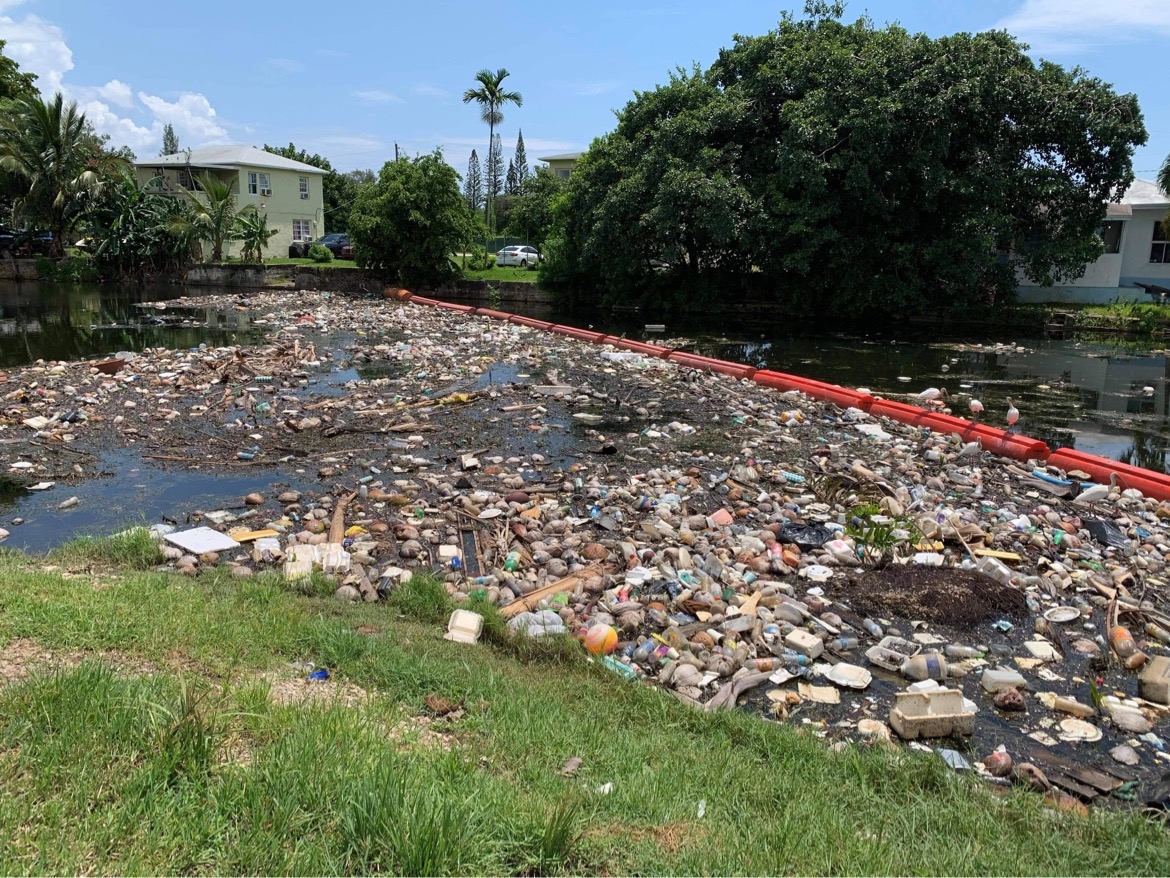
On July 25, a community member reported an accumulation of pollution on the Little River Canal that they observed while kayaking in the morning. The report noted that there was a collection of plastic debris and floating vegetation at the site. The observations from this incident were shared with the County and the South Florida Water Management District. As a result, the heap of pollution at this site was cleaned up two days later. To address the accumulation of pollution faster along this area of the river, the District moored a tow-boat at this location for the remainder of the wet season.

The pollution at the Little River Canal on July 25 when the pollution was reported.

The Little River Canal after the South Florida Water Management District addressed the pollution report on July 27.
How can you help curb illicit pollution?
Join our volunteer-based, community-led water patrol team to expand our ability to monitor Biscayne Bay by taking our 1,000 Eyes on the Water program, which is available in English and Spanish. Community members can learn how to properly report sedimentation, algal blooms, oil slicks, and fish kills and aid in protecting Biscayne Bay’s water quality.
What happens when you report pollution to MWK?
When our pollution response team receives a report from a community member, they are most concerned with the kind of pollution and its location. The team communicates the information with the appropriate agencies, like the City, County, or the State, and other parties that can address the incident like the U.S. Coast Guard or the Florida Fish and Wildlife Conservation.
Details and timeliness are of the utmost importance to pollution reports. The more closely the pollution report is made to its initial observation, the more rapidly it can be responded to and resolved. The information that is necessary for a successful response is below.
- Date of Incident
- Time of Incident
- Type of Incident (Oil spill, sedimentation plume, fish kill, algae bloom, discharge of a substance, etc.)
- Location/Waterbody (The nearest address or latitude and longitude)
- Landmarks (The closest landmarks to the incident make it easier for responders to find the pollution)
- Vessel type (In the case that a vessel is causing pollution)
- Description of the incident
- Photos/videos of the incident
Your information is entirely anonymous unless you permit us to provide your information to the agencies that we communicate with.
Once this information is sent to agencies that can address the incident, we follow up to determine if action was taken and if violations were given. Pollution reports must be made as close to the observation time to ensure that the pollution is still present when it is responded to for further investigation.
Click HERE to take the 1,000 Eyes on the Water program.
Click HERE to report pollution.
Originally published at https://www.miamiwaterkeeper.org/pollution_report_results_in_major_little_river_clean_up