
On July 29th, 2020, our very own Waterkeeper, Rachel Silverstein, joined panelists in the ‘Sustaining Miami’s Waters’ webinar. Hosted by FIU Institute of Environment and the City of Miami, this one-hour discussion covered the challenges of sustaining Miami’s properties and yards, and elaborated on what the community can do to protect our environment, way of life, and drinking water quality.

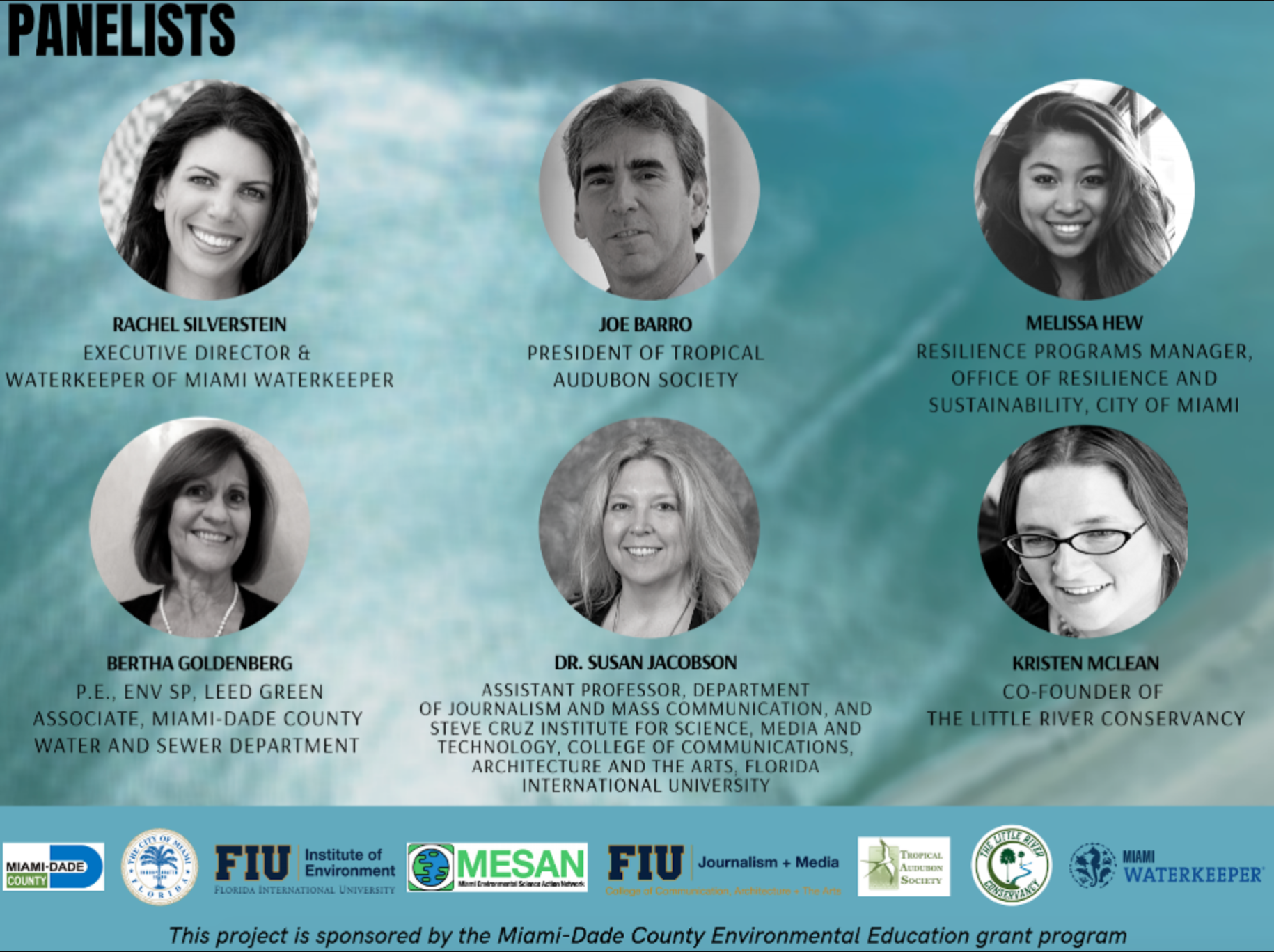
Panelists included:
Dr. Rachel Silverstein, Executive Director and Waterkeeper of Miami Waterkeeper
Joe Barro, President of Tropical Audubon Society
Melissa Hew, Resilience Programs Manager, Office of Resilience and Sustainability, City of Miami
Bertha Goldenberg, P.E., ENV SP, Leed Green Associate, Miami-Dade County Water and Sewer Department
Dr. Susan Jacobson, Assistant Professor, Department of Journalism and Mass Communication and Steve Cruz Institute for Science, Media and Technology, College of Communications, Architecture and the Arts, Florida International University
Kristen McLean, Co-founder of The Little River Conservancy
Dr. Silverstein’s presentation, “How Your Municipality Can Reduce Pollution,” highlighted the many complications associated with nutrient pollution and how it is currently threatening Biscayne Bay. Fertilizers, sewage leaks, septic tanks, and stormwater runoff are major contributors to nutrient pollution in our waterways.

A significant contributor is excess fertilizer use, both commercial and residential. Too much fertilizer washing into the water can feed algal growth and blooms, which contribute to seagrass die-off. Most people use too much fertilizer on their lawns, which means that the excess that is not taken up by landscape plants and turf grass gets washed into storm drains and ultimately into our watershed. Especially during rainy summer months, fertilizer is more likely to run off into waterways before plants can even use it.

The presentation addressed Miami Waterkeeper’s efforts in working with municipalities across South Florida, such as the City of Miami, to implement fertilizer ordinances and subsequent public education campaigns and materials. Fertilizer ordinances were highlighted as an effective measure to address one source of nearshore nutrient pollution in South Florida. These ordinances focus on best management practices for fertilizer application in a subtropical region such as South Florida, which has frequent rain. Strong fertilizer ordinances will not only protect our environment and waterways but will save municipalities and residents money. The City of Miami passed a “gold standard” fertilizer ordinance in March of this year, which is now the strongest fertilizer ordinance in the state. Dr. Silverstein also discussed Miami Waterkeeper’s hope for Miami-Dade and Broward counties to take on the ordinance as well.
Other panelists covered topics including water quality, human-induced pollution, MESAN Monitoring Application, and more. Following individual presentations, all speakers participated in a discussion and Q & A portion. If you missed the webinar or would like to learn more, click HERE to watch the full webinar.
To learn more about our campaign to ‘Reduce Fertilizer Use’ click HERE.
Originally published at https://www.miamiwaterkeeper.org/miami_waterkeeper_participates_in_fiu_s_sustaining_miami_s_waters_panel