
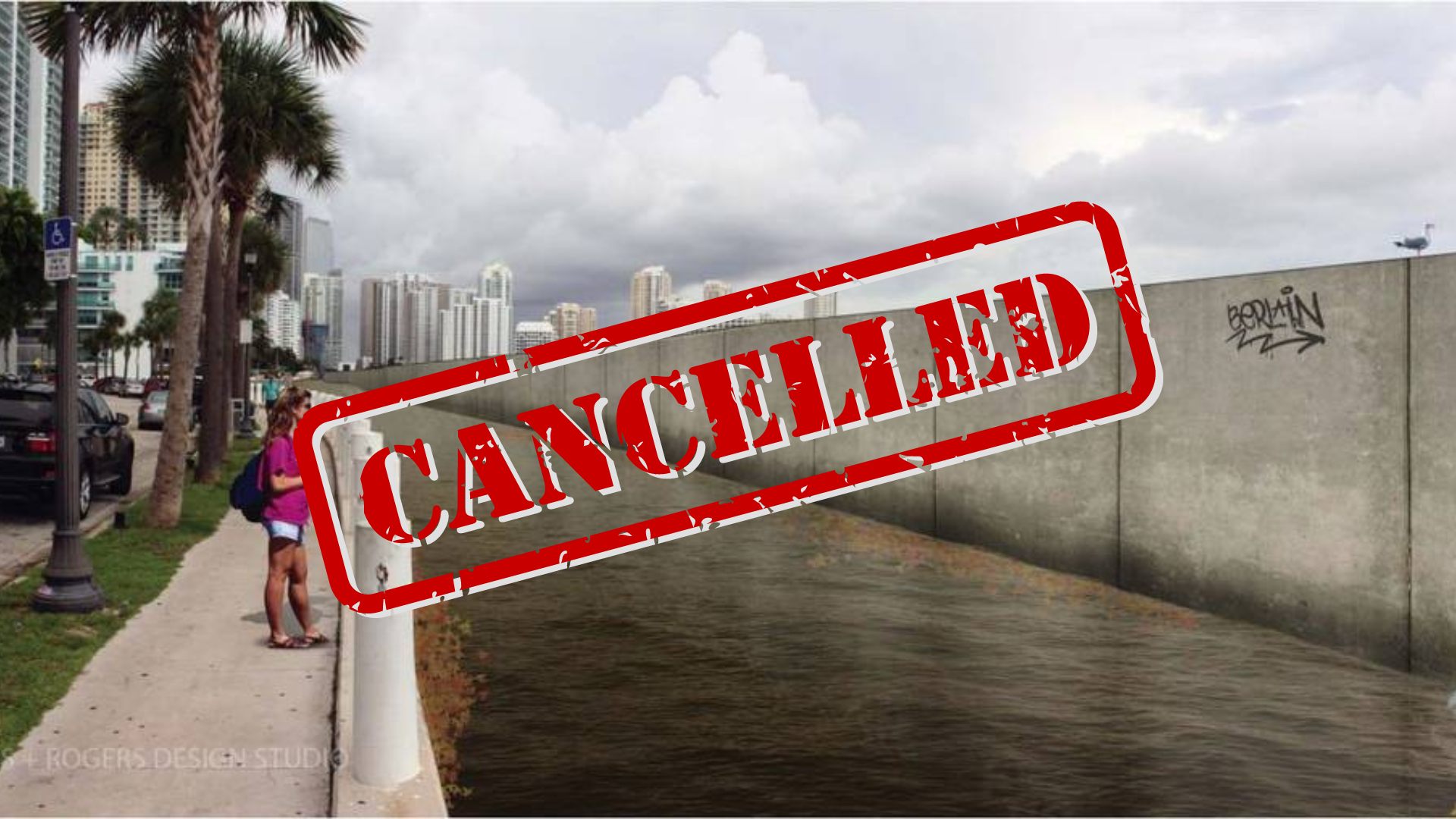
Remember “the wall”? After you all made your voices heard, the Back Bay Study is entering a new phase! We now have the chance to change the course of this project to include more nature and nature-based features.
What does this mean for you? Keep reading to find out!
What is the Back Bay Study?
The “Back Bay Study” is a federally-funded investigation into ways to reduce storm surge in Miami-Dade County. After years of research, in 2020, the U.S. Army Corps of Engineers proposed an unacceptable $6+ billion plan that largely relied on options like giant walls in Biscayne Bay and flood gates, but left out nature-based solutions like mangrove and restoration and living shorelines. This plan would have exacerbated equity problems, picked “winners and losers” and created environmental harm — without making us safer. You can read the original proposal HERE.
Why Was The Study Put On Hold?
The study was put on hold due to pushback from Miami residents and environmental groups, like Miami Waterkeeper, who argued that some of the proposed solutions would do more harm than good. Ultimately, the Mayor of Miami-Dade County pulled the plug on the plan, seeing it was not going to work for Miami. As ground zero for sea level rise and a hurricane-prone region, Miami needs big investments in resiliency. But the plan has to work for our community and our environment too.
What’s Next?
After Mayor Levine Cava pushed for the Corps to reconsider the original plan, the Corps agreed to pay for the new study itself at no cost to Miami-Dade County. To this end, the Army Corps and the County held a joint meeting on October 12, 2022, to discuss the Back Bay Study re-initiation. A recording of the meeting can be found below.
Save the Date for the Next Public Meeting
Beginning Monday, November 14, there will be a week-long charrette hosted by the Army Corps and the Miami-Dade County Office of Resilience (OOR). The dates and locations can be found on the OOR’s events calendar page (toggle to view by week).
Additionally, the Corps is soliciting comments through their web-based portal. As of the time of publication of this blog, the portal is open and they are still receiving input from the community. Miami Waterkeeper encourages folks to add their thoughts and ideas, as this is such an important issue that will have a significant impact on our human habitation and environment.
As the Army Corps of Engineers reconsiders the Back Bay study with more local input, we hope that government planners and the community can come together to explore additional ways to incorporate nature and nature-based features, consider nonstructural measures, and protection of additional critical infrastructure – all things that Miami Waterkeeper advised in its previous comment letter, such as the following:
- Investments in stormwater retrofits to improve retention areas, treatment and filtration
- Investments in septic to sewer conversion, especially in Little River and Arch Creek areas
- Fortifications of the County’s sewage treatment plants
- Living shorelines/green infrastructure
- Coral restoration of the only near-shore coral reef in the continental U.S.
- Protection for the Turkey Point nuclear power plant
- Must consider groundwater impacts and canal management
- Must not make sea level rise-based flooding worse while addressing storm surge
- Plan for using the highest sea level rise curves produced by the National Oceanographic and Atmospheric Administration
- Base cost-benefit analysis on social vulnerability and human impacts, over property values, so as not to exacerbate inequity.
- Avoid disrupting neighborhoods
- Avoid creating environmental damage by constructing and operating massive structures in our sensitive Bay and waterways.
- Leverage existing, community-based resiliency plans, such as Resilient305 and others
Originally published at https://www.miamiwaterkeeper.org/back_bay_study_is_reconsidering_storm_surge_solutions