
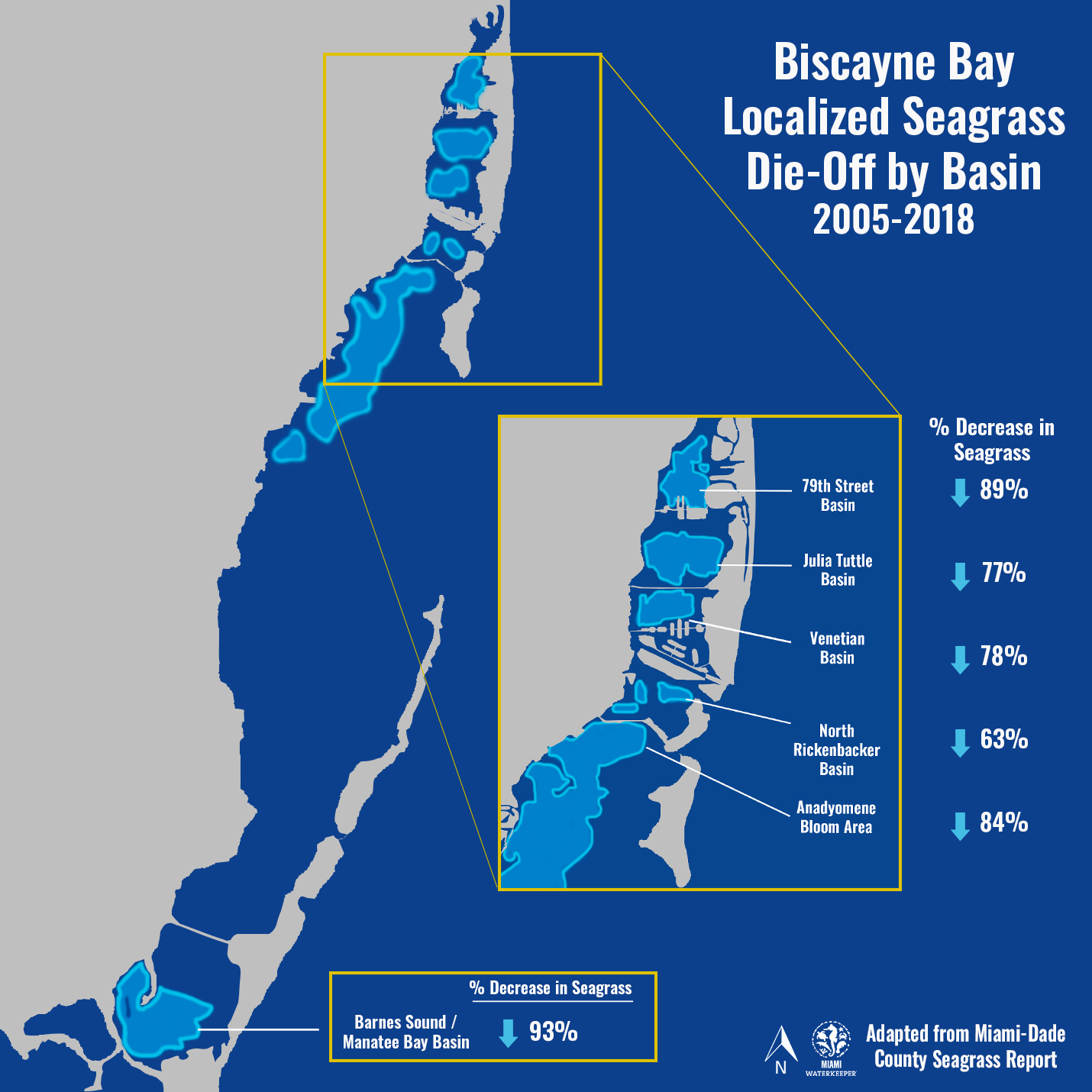
Biscayne Bay’s Localized Seagrass Die-Off By Basin

Seagrasses are one of Biscayne Bay’s critical habitats. Seagrass beds serve as a food source, a habitat for small marine organisms, and they regulate water quality by stabilizing sediments and cycling nutrients. However, seagrass cover in the Bay has drastically declined over the last decade. Miami-Dade County’s recent report, “Report on the Findings of the County’s Study […]

Back

Seagrasses are one of Biscayne Bay’s critical habitats. Seagrass beds serve as a food source, a habitat for small marine organisms, and they regulate water quality by stabilizing sediments and cycling nutrients. However, seagrass cover in the Bay has drastically declined over the last decade. Miami-Dade County’s recent report, “Report on the Findings of the County’s Study on the Decline of Seagrass and Hardbottom Habitat in Biscayne Bay,” highlights underlying factors that are causing these die-offs and provides a series of recommendations to help direct the County’s approach moving forward. Read the full report and list of recommendations HERE

Map illustrating the several basins located throughout Biscayne Bay, and the percentage of seagrass coverage decline over the last 13 years. (Source: Miami Waterkeeper; Miami-Dade County 2019 Seagrass Report).


Seagrass coverage over the last 10 years:

Seagrass coverage has significantly declined in Biscayne Bay over the last 10-20 years. The most notable area in Biscayne Bay experiencing this decline is near the Julia Tuttle Causeway. Seagrass coverage decreased by nearly 90% in some areas around the Causeway. The problem with seagrass decline is that once it’s removed from the ecosystem, it’s very hard to restore and recover. 

Google Satellite images of seagrass coverage, represented in darker shading, near Julia Tuttle Causeway in 2011 (pictured left), contrasted with coverage in 2016.

High volumes of nutrients from leaky septic systems and sewage spills (SSOs) as well as fertilizer runoff are a few of the contributing factors causing the decline in seagrass coverage. As an estuary, Biscayne Bay requires both fresh and saltwater to support its diverse ecosystem. While the Bay receives freshwater through the region’s intricate canal system, the quality of that freshwater can be poor. This poor water quality is having measurable impacts on the Bay and is likely contributing to the localized seagrass die-offs we are seeing in the Bay. 

Interested in learning more about how you can improve local water quality? Read more HERE

Originally published at https://www.miamiwaterkeeper.org/biscayne_bay_s_localized_seagrass_die_off_by_basin

Tags:

Get updates about our work

We respect your privacy.

Media Coverage

Stories of Accountability & Recovery

Miami Waterkeeper has been cited by local and national outlets as a trusted source on South Florida water quality, policy, and environmental justice.

Miami Herald

A developer financed a film on what ails Miami. He says developers can do better

September 14, 2026

The Miami Herald previewed “The Future We Build,” a new short documentary on the compounding crises facing Miami, opening with environmental advocate Rachel Silverstein…

Read more

Italy Report USA

Miami Beach Promossa a Pieni Voti nella Gestione delle Acque Piovane

August 29, 2026

Italy Report USA reported on the Stormwater Report Card — produced by Miami Waterkeeper with the Everglades Law Center and the University of Miami’s environmental program — highlighting Miami Beach’s strong marks for managing stormwater….

Read more

WTVJ-TV – NBC 6 South Florida

Another Dredging Project on Hold in Broward Amid Coral and Conch Concerns

August 21, 2026

NBC 6 South Florida covered the pause on another Broward dredging project amid concerns for coral and queen conch, quoting Miami Waterkeeper CEO Rachel Silverstein on a coral she described as “functionally extinct in the state of Florida.” Our group is one of those behind the challenge….

Read more

Support our work

We’re committed to transparency, accountability, and maximizing the impact of every dollar entrusted to us. Be part of the change and donate today!

Florida Solicitation of Contributions Registration #CH46021 A copy of the official registration and financial information for Biscayne Bay Waterkeeper (aka Miami Waterkeeper), a Florida-based nonprofit organization, may be obtained from the Division of Consumer Services by calling toll-free 1-800-HELP-FLA (435-7352) within the state or visiting www.800HELPFLA.com. Registration does not imply endorsement, approval, or recommendation by the state.