
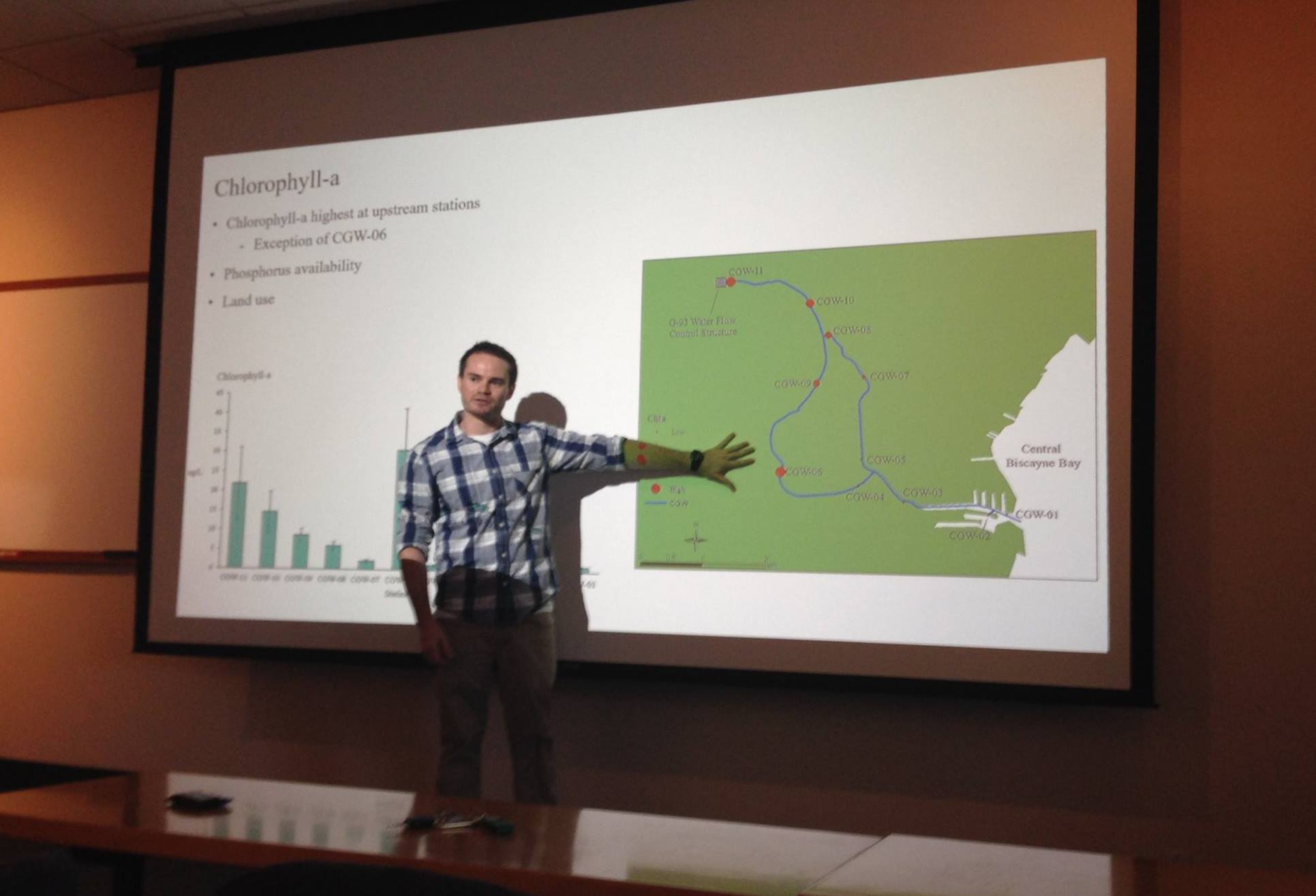
 David Bouck presenting his Master’s thesis entitled “Determining Trends in Water Quality Using High Resolution Land Use Data”
Biscayne Bay and its surrounding waterways are widely known as ecologically important areas. Coral reefs, seagrasses and mangroves protect nearly everything from juvenile fish to us as inhabitants of this large urban region. As part of their Habitat Blue Print program, the National Oceanic and Atmospheric Administration (NOAA) made this loud and clear when they chose Biscayne Bay as one of 10 Habitat Focus Areas to focus their time and resources on conserving this important estuary. the Habitat Focus Areas have one thing in common- they are at an ecological tipping point and need help from scientists and other advocates to save them before it is too late. Miami Waterkeeper headed up a NOAA Habitat Focus Area grant, in partnership with many key players at the University of Miami and UF/IFAS Florida Sea Grant, to address “The Human Dimensions of Biscayne Bay: Socioeconomics, Spatial Modeling, and Community Engagement.” Under this grant, Master’s candidate David Bouck completed research related to nutrient loading in Biscayne Bay that was crucial to enhancing our understanding of the Bay’s evolving water quality. Learn more about Bouck and his contribution to protecting this focus area!
 This shows the majority of other Habitat Focus Areas highlighted by NOAA.
Tell us a little about yourself and your background in marine science.
I grew up on the island of Marthas Vineyard, in Massachusetts, where issues pertaining to marine resources and coastal zone management were a regular part of my day to day experience. Some of my earliest memories are of beachcombing and swimming in the waves. My curiosity surrounding our intersection of land and sea drove me to spend thousands of hours exploring the coastal habitats of my home. My career interest in marine science developed throughout high school and college. During this time I worked as an environmental educator and conservation ranger at a wildlife refuge that encompassed several very sensitive coastal habitats on the island. I witnessed first-hand the difficulties involved in protecting natural resources while simultaneously allowing access to the public. During undergrad, I was fortunate to participate in a wide variety of research and management projects spanning from working as a crewmember onboard the Woods Hole Oceanographic Institute’s Student Science Vessel Corwith Cramer, to assisting in watershed restoration research in Central Veracruz, Mexico. After undergrad, I spent multiple years working for the National Park Service on the Big Island of Hawaii, as a volunteer and field technician for several endangered species management programs spanning from sea to summit.
Briefly, can you describe your Master’s thesis purpose and results?
My thesis explored the use of high-resolution water quality and aerial imagery datasets in analyzing connections between localized land use and seasonal nutrient loading in the Coral Gables Waterway.
What attracted you to this particular research project?
As part of my graduate internship with National Oceanic and Atmospheric Administration (NOAA) in Miami, I assisted in the collection, processing, and interpretation of biological and water quality data for the NOAA Habitat Blueprint Program’s, Biscayne Bay Habitat Focus Area (BBHFA). One of the central issues for the BBHFA is studying and understanding the mechanisms that contribute to persistent macro-algal blooms throughout this area. Personally, I am very interested in human-ecosystem interactions, resource management, and sustainability. This project seemed like a perfect opportunity to help investigate some of the key issues of the BBHFA, while also incorporating my primary interests.
How did the NOAA Habitat Focus Area Grant awarded to MWK help you in your research?
My project was primarily computer-based and very time intensive. The grant helped to defray my living expenses and made it possible for me to dedicate the time necessary to complete my analysis. It would have been impossible to get it done without it!
What was the most surprising finding(s) of your research?
One of the more interesting portions of my analysis was mapping and interpolating the spatial distribution of nutrients throughout the lower end of the Coral Gables Waterway. Observed spikes of nitrogen, phosphorus, and chlorophyll, in specific areas, raised many questions about flow dynamics in the waterway and the impacts of nearby land use. My subsequent statistical analysis using land classification data helped reinforce some of these observed relationships. As a result, it fostered discussion about the implementation of small-scale mitigation measures in the canal.
How did this research help you in your career/help you in the field where you’re at now?
My time spent at RSMAS and working for NOAA helped to crystallize my understanding of effective resource management and the proper implementation of research. The technical skills I acquired from both collecting/processing water samples and from conducting spatial analysis using Geographic Information Systems (GIS) are invaluable. I was awarded my current position with the United States Geological Survey primarily due to my experiences in Miami. Looking forward, I hope to continue developing these skill sets as my career in resources management unfolds.
It has been a pleasure working to save Biscayne Bay, David!
Check out David’s thesis HERE!
Originally published at https://www.miamiwaterkeeper.org/mwk_spotlight_david_bouck