

Thanks, but no tanks! MWK comments on state septic rule-making

Miami-Dade County has known for over 50 years (!) that septic tanks in our urban, low-lying coastal area are dangerous to public and environmental health. In 1970, the Federal government conducted a study (citation below) reporting that “Septic tanks, widely used in Dade County, are public health hazards and contribute to over-fertilization and algal nuisances […]

Back

Miami-Dade County has known for over 50 years (!) that septic tanks in our urban, low-lying coastal area are dangerous to public and environmental health. In 1970, the Federal government conducted a study (citation below) reporting that “Septic tanks, widely used in Dade County, are public health hazards and contribute to over-fertilization and algal nuisances in adjacent waterways.” The study further stated that new septic tanks should no longer be constructed and that county-wide sewage collection and treatment systems should be expanded.

We agree. Septic systems were a problem in 1970, and they are  a problem now. South Florida’s geology is porous and rapidly transmits groundwater without a lot of natural filtration through soil and rocks. Moreover, not all people maintain or have the means to maintain their systems. 

The contamination from leaky, old septic systems has contributed to increased algae in waterbodies, loss of seagrass in Biscayne Bay, lowered oxygen levels, and the recent alarming fish kills. With seas rising throughout this century, many septic systems will become even more of a hazard to human health and our waterways: tanks flooded by water from above or below will be rendered ineffective. This means that raw sewage carrying pathogenic bacteria and viruses will back up into homes or pollute floodwaters in folk’s neighborhoods — floodwaters that people might have to wade through to get to their cars or public transit, or even just to walk through their yards.

When the Florida Department of Environmental Protection (FDEP) asked for public comments on septic system permitting, we sent a detailed letter that emphasized  these concerns. Miami Waterkeeper’s comments are intended to advise FDEP on how to set science-based setback distances so that septic systems are placed away from sensitive waterbodies, rising groundwater, and encroaching seas. Please read our letter here.

Citation:

United States Department of the Interior, Federal Water Quality Administration (FWQA) (1970) Pollution of the Waters of Dade County, Florida.
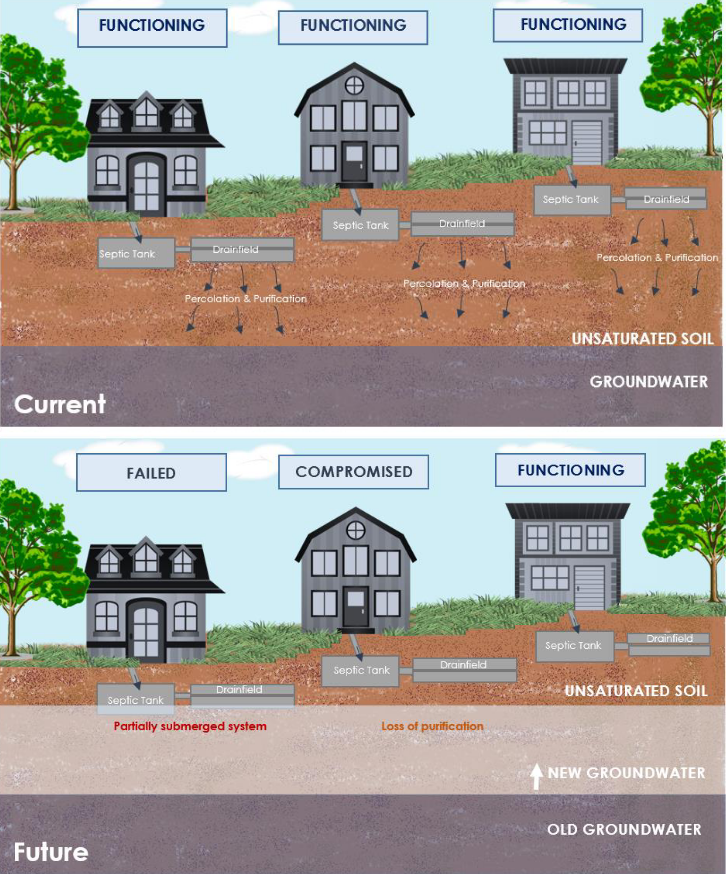
 

Sea Level Rise, Septic Systems, and Resilience and Retreat — Wetlands Watch

Originally published at https://www.miamiwaterkeeper.org/thanks_but_no_tanks_mwk_comments_on_state_septic_rule_making

Get updates about our work

We respect your privacy.

Media Coverage

Stories of Accountability & Recovery

Miami Waterkeeper has been cited by local and national outlets as a trusted source on South Florida water quality, policy, and environmental justice.

Press Release

NEWS: Corps Temporarily Halts Fort Lauderdale Dredging Project After Conservationists’ Lawsuit

August 13, 2026

For Immediate Release, August 13, 2026 The U.S. Army Corps of Engineers has agreed to halt authorization of all dredging activity for Broward County’s…

Press Release

Conservationists Challenge Dredging Project Near Port Everglades Over Endangered Species Act Violations

August 6, 2026

Miami Waterkeeper, the Center for Biological Diversity,  Florida Wildlife Federation and the Diving Equipment & Marketing Association sued the U.S. Army Corps of Engineers and the National Marine Fisheries Service on Tuesday for violating the Endangered Species Act when permitting a sand dredging project near Port Everglades….

Press Release

Miami-Dade Cities Overall Improve Stormwater Compliance, but Biscayne Bay is still at Risk

June 3, 2026

A coalition of environmental organizations released the Stormwater Report Card for Miami-Dade County, a comprehensive, independent assessment of how the county and its 34 municipal permittees manage polluted stormwater…

Support our work

We’re committed to transparency, accountability, and maximizing the impact of every dollar entrusted to us. Be part of the change and donate today!

Florida Solicitation of Contributions Registration #CH46021 A copy of the official registration and financial information for Biscayne Bay Waterkeeper (aka Miami Waterkeeper), a Florida-based nonprofit organization, may be obtained from the Division of Consumer Services by calling toll-free 1-800-HELP-FLA (435-7352) within the state or visiting www.800HELPFLA.com. Registration does not imply endorsement, approval, or recommendation by the state.