
When Miami Waterkeeper talks to the community about sea-level rise, people will share stories of their “ah-ha” moment – when the magnitude of the threat of rising seas finally hit them. Their stories have a common thread: it took time for them to comprehend the warnings from scientists and academics that seemed so lofty and maybe a bit alarmist. But then they saw it for themselves, and seeing it was key. For one person, it was the tidewater rushing over the walkway in a coastal park where they go jogging making it impossible to pass at certain times of the year. For another person, it was noticing the changes in coastal vegetation: brackish water plants are now being replaced by salt-tolerant mangroves as the saltwater tides pushes further inland.
Globally, the mean sea level has risen about 8-9 inches in the past 140 years. A third of this increase has occurred in the last 25 years.
Scientists at the National Oceanographic and Atmospheric Administration (NOAA) keep track of the rising seas. NOAA, along with their agency and academic partners, published a report on February 15, 2022. This report is an update to previous reports. As scientists take more measurements on climate change and rising seas, each successive report provides more certainty about our future. A local scientist, Jayantha Obeysekera at Florida International University’s Sea Level Solution Center, contributed to this report and was featured in a Miami Herald article.
NOAA’s 2022 report provides more clarity on where we’re headed. First the good news: the report revises downward the amount of sea level rise South Florida is reasonably expected to see in the short term. NOAA’s previous report (2017) predicted 17 inches of sea level rise by 2040 in our region, as measured from the mean sea level in 2020. In the 2022 report, NOAA predicts 11 inches of sea level rise in South Florida, as measured from the same mean, in an intermediate-high scenario (the scenario that most planners use to design for the future).
Now the bad news: 11 inches of sea level rise is still a lot and could be catastrophic when combined with a hurricane surging past the coastline and into the city.
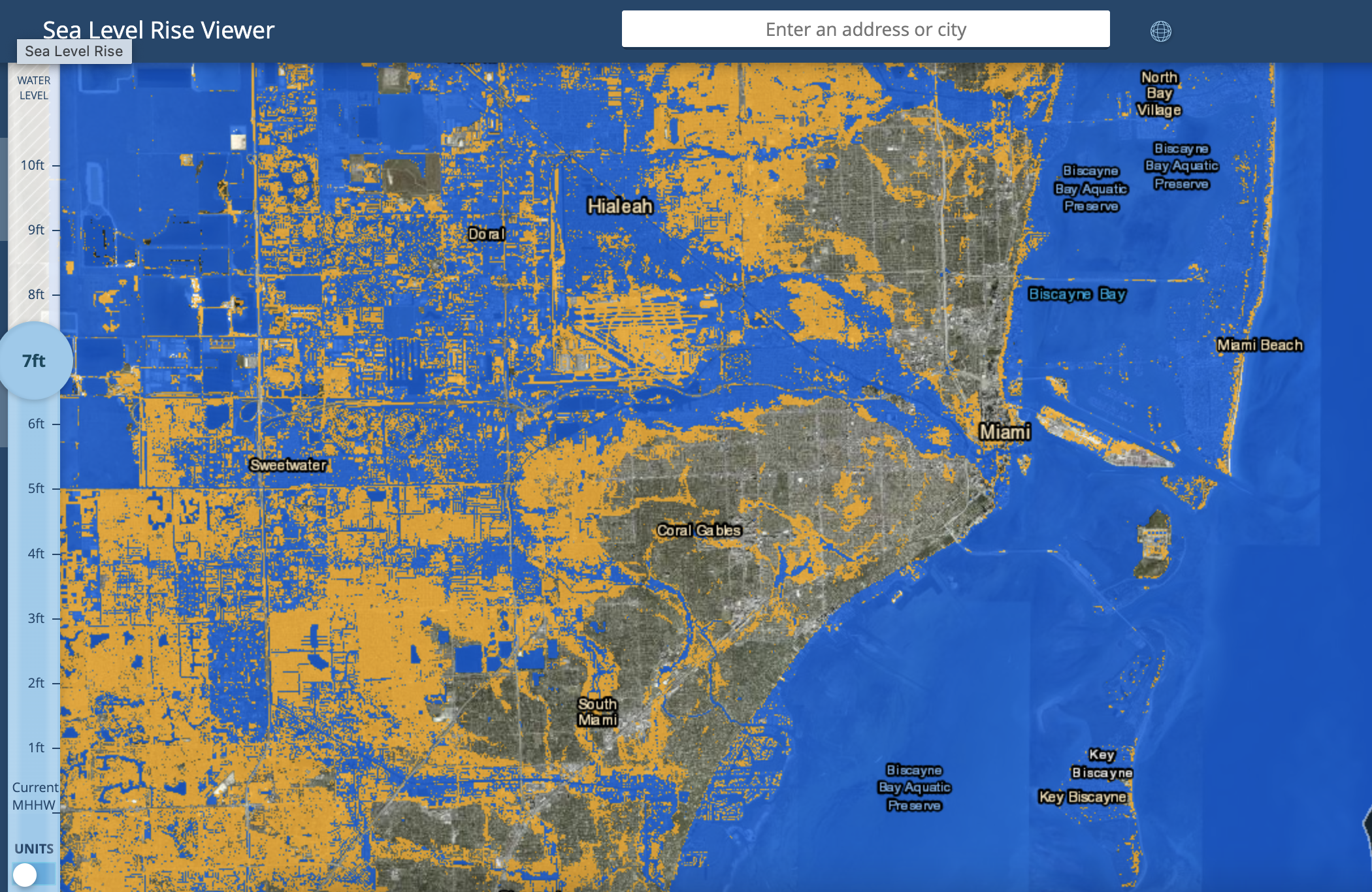
Now the worst news: the high scenario revises upward the worst case scenario – if we fail to curb greenhouse gasses. In this scenario, sea levels could reach 7 feet above 2020 levels by the year 2100, one foot upward of what the previous report predicted.
We mentioned before that seeing the sea rise underscores the sense of urgency related to doing something about climate change. You can do this without sloshing through sunny day flooding: NOAA has created a sea level rise viewer to help people visualize the effects under different, future scenarios. View it here: https://coast.noaa.gov/slr/#
Originally published at https://www.miamiwaterkeeper.org/noaa_february_2022_slr_projections